
REVIEW · CLARE
Private Ennis Essential History Tour with Dr Jane O’Brien
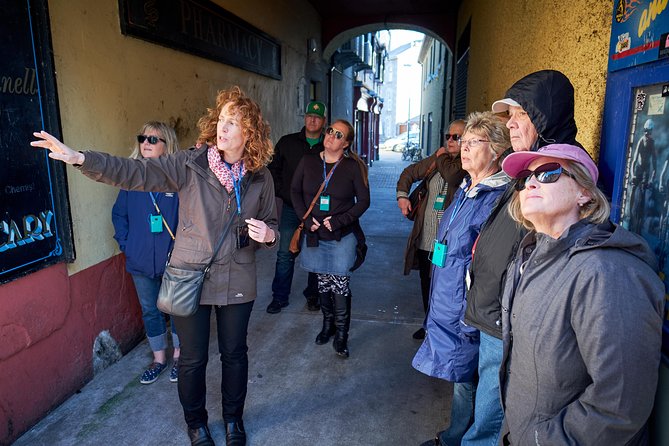
Ennis has stories in every corner. On the Private Ennis Essential History Tour with Dr Jane O’Brien, you get a tight, teacher-led walk through the medieval market town, with the kind of detail that makes daily life and big political moments feel close. I especially like the way Dr Jane uses historical sources to recreate what Ennis was really like, and I love that the route is practical, so you cover a lot of ground without feeling rushed into a long day.
Dr Jane O’Brien runs the show, using an amplification option if you want easier listening, which helps on busy streets.
One thing to keep in mind: this is about 1 hour 10 minutes, with a lot of short stops. If you want time to linger inside buildings or in-depth museum-style viewing, you may wish you had a bit more duration.
In This Review
- Key highlights worth timing your day for
- A private Ennis history walk with Dr Jane O’Brien
- Why the route feels like real Ennis, not a checklist
- Stop-by-stop: Clare Museum to the Cathedral of Saints Peter and Paul
- 1) Clare Museum area, formerly the Convent building for the Sisters of Mercy
- 2) Daniel O’Connell Monument in central Ennis
- 3) Abbey Street laneways, the atmospheric bow-ways
- 4) Ennis Friary by the Old Ennis Abbey area, plus river Fergus and 1916 memorials
- 5) Francis Street and the O’Brien Kings connection, then the 1850s friary stained glass
- 6) Arthur’s Row and the convent site tied to children’s experiences
- 7) Parnell Street and McParland House, a rare surviving timber-framed home
- 8) Chapel Lane, penal times, and the impact of the Great Famine
- 9) Market Place, hundreds of years of trade and social life
- 10) Barrack Street and Gallows Green memories
- 11) Cathedral of Saints Peter and Paul and the option to keep exploring
- Listening comfort, timing, and what you should bring
- Price and value for small groups
- Who this Ennis Essential History Tour fits best
- Should you book this Ennis Essential History Tour?
- FAQ
- How long is the Private Ennis Essential History Tour?
- What is the group size for this private tour?
- What does it cost?
- What language is the tour offered in?
- Is an amplification device available?
- Where does the tour start and end?
- Is the admission free for the stops listed?
- Can I cancel and get a full refund?
Key highlights worth timing your day for
- Private group, up to 6 people means you can ask questions without waiting your turn
- Historical storytelling by Dr Jane O’Brien brings Ennis’s everyday life to the front of the lesson
- Amplification device available for clearer listening at street level
- A smart walking loop that hits major sites and the quieter lanes in between
- All stops with free admission along the way, so you pay for the guide, not tickets
- Ends at the Cathedral of Saints Peter and Paul, with an easy choice to keep exploring on foot
More days out across the limestone
- Public Ennis Walking Tour with Local Expert Dr Jane O’Brien★ 5.0 · 262 reviews
- Private Ennis Essential History Tour with Dr Jane O’Brien★ 5.0 · 34 reviews
- Cliffs of Moher and The Burren day trip★ 5.0 · 12 reviews
- Cliffs of Moher & Bunratty Castle Day Tour★ 5.0 · 9 reviews
A private Ennis history walk with Dr Jane O’Brien
If you like history, you know the problem. Museums can be great, but they rarely show you what it felt like to live in a town. This tour solves that by working through Ennis on foot, stopping where buildings, lanes, and monuments still hold the clues.
Dr Jane O’Brien keeps the focus on people, not just dates. You’ll hear about Ennis as a 13th-century market town that grew into the Co Clare hub for trade and social life. And you’ll also connect the dots between faith, politics, and hardship, from Catholic Emancipation to the pressure points of the Great Famine.
At the same time, it’s not a lecture you’re trapped in. The group moves along a central route that’s easy to follow, and the stops are brief enough that you keep moving while still getting meaningful explanations.
Why the route feels like real Ennis, not a checklist
This tour is built around Ennis’s “in-between” spaces, not just headline monuments. You’ll spend time looking down the smaller lanes and laneways, the kinds of routes you’d easily walk past on your own. That’s where the stories land, because the town’s history is shaped by how people got around, where they gathered, and who lived where.
A second reason it works is the contrast between quiet and serious. You’ll get gentle, scenic moments like the river Fergus view, then pivot quickly to heavier topics like imprisonment, executions, orphanage and industrial school experiences, and the social shock of famine era overcrowding. The balance is part of what makes the whole walk feel honest.
Finally, the logistics are simple. It’s English, it runs on a mobile ticket, and the tour usually ends right where you can keep exploring without backtracking through the whole town.
Stop-by-stop: Clare Museum to the Cathedral of Saints Peter and Paul
Here’s what the hour and change looks like, and what each stop does for your understanding of Ennis.
1) Clare Museum area, formerly the Convent building for the Sisters of Mercy
You start beside the Clare Museum. The spot matters because it was once the site of a Convent building for the Sisters of Mercy. From here, Dr Jane frames Ennis as a medieval market town that took shape in the 1200s, a town whose growth was tied to trade, religion, and the everyday rhythm of people moving in and out.
Even if you do not go inside the museum itself, starting here gives you the town’s origin story in one place, then you head out into the streets.
Other trips where the minibus is yours alone
2) Daniel O’Connell Monument in central Ennis
Next comes the Daniel O’Connell Monument in the center of town. It’s tied to major events, including the milestone of Catholic Emancipation. This stop helps you understand how political change played out in real spaces, not just in textbooks.
If you’ve ever wondered why 19th-century Irish history feels so personal, this is where it starts to make sense. You’re standing where public events and remembrance were shaped by that struggle.
3) Abbey Street laneways, the atmospheric bow-ways
Then you slip into one of Ennis’s bow-ways, those narrow laneways linking main streets to the older, poorer tenement areas. This is a quick stop, but it changes how you read the town. Suddenly, the layout of Ennis feels like part of the story, not just a convenient walking route.
These lanes are where you can picture daily life more easily, because the spaces feel made for close quarters and community movement.
4) Ennis Friary by the Old Ennis Abbey area, plus river Fergus and 1916 memorials
By the Old Ennis Abbey area from the 1280s, you explore the role of the Franciscan Friars in the development of Ennis. Friars were not just religious figures, they were part of the town’s social structure and influence.
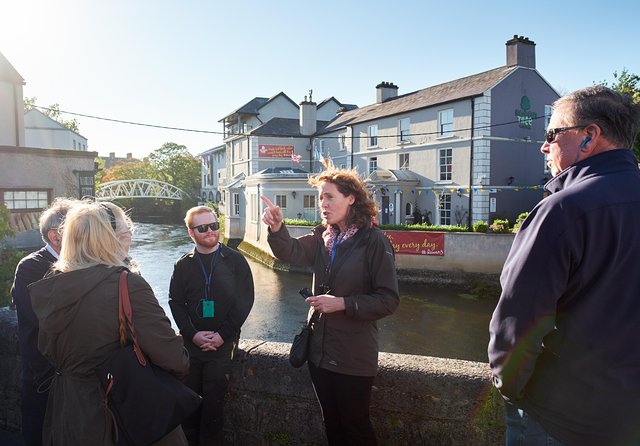
From there, you get a pretty view of the river Fergus flowing through Ennis. And you also encounter memorials connected to the 1916 uprising against British rule. This stop holds both beauty and gravity, and it gives the tour a wider national context.
5) Francis Street and the O’Brien Kings connection, then the 1850s friary stained glass
On Francis Street, you visit a strip of Ennis that connects to the palace of the O’Brien Kings, the founders of the town. This is where you start seeing why Ennis feels like it has layers, with older power structures still referenced in street logic.
You also visit a friary originally built in the 1850s, and you get to experience the beautiful stained glass windows and a more peaceful atmosphere. If you enjoy the feel of quiet spaces in busy towns, this is one of the best breathing points in the loop.
6) Arthur’s Row and the convent site tied to children’s experiences
Arthur’s Row takes you back to the old convent building and the archived experiences of children from the orphanage and industrial school that once stood on the site. This is one of the heavier moments of the tour, and it’s also where the “essential” part matters.
It’s not just about what happened, it’s about how institutions shaped lives in very practical, physical ways. You’ll come away with a clearer sense of what a town’s care systems meant on the ground.
7) Parnell Street and McParland House, a rare surviving timber-framed home
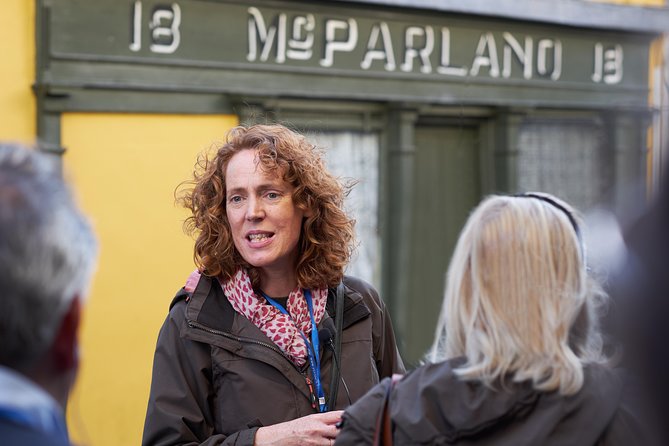
At Parnell Street, you stop at McParland House, from around 1620. It’s described as the only known surviving timber framed house in Ireland, and it’s also the oldest house of the town to remain in continuous use without major structural alterations.
The details you hear about are the kind that make old houses feel real. The quaint shopfront and the half-door offer a tangible sense of an earlier market-town rhythm, where home and commerce overlapped.
8) Chapel Lane, penal times, and the impact of the Great Famine
Chapel Lane brings in the penal times, when a church built in 1735 operated in that difficult context. The lane itself helps you picture overcrowding during the Great Famine in Ireland, and the devastation it caused in a town like Ennis.
This stop is short, but it gives you a strong emotional frame for why famine era Ireland is still spoken about with such weight. You’ll likely look at the street layout a little differently afterward.
9) Market Place, hundreds of years of trade and social life
The Market Place is where Ennis’s long market life comes to the front. As the main market town for Co Clare, Ennis served as a center for markets for hundreds of years, built around trading livestock and produce.
The guide also connects markets to social life, with people meeting up, matchmaking, and yes, the infamous faction fighting. It’s a reminder that “shopping day” used to include real tension as well as community.
You’ll also learn about the meaning behind the market day sculpture standing on the site today, which helps connect past and present rather than treating history like a museum label.
10) Barrack Street and Gallows Green memories
Barrack Street is tied to what was once the town’s Gallows Green. Here, you hear about crimes and punishments documented in the Ennis corporation manuscript of 1660.
It can be shocking by modern standards. That’s not to spoil the mood, it’s to show you how public justice was experienced, where communities gathered, and why order and fear shaped daily life.
11) Cathedral of Saints Peter and Paul and the option to keep exploring
The last stop is the Cathedral of Saints Peter and Paul, built between 1830 and 1870, the main Catholic church of the region. It sits opposite the Old Ground Hotel, which was once the site of the old town jail, and the cathedral incorporates a haunted towerhouse dating to the 1500s.
The tour usually ends here, with the option to visit the cathedral or to return to your starting point via O’Connell Street. Either way, you’re set up to keep walking in a normal, low-effort way.
Listening comfort, timing, and what you should bring
The route is best for people who like walking and can handle short pauses. You’re moving through town with frequent quick stops, so your legs get exercise, but it stays manageable.
Two practical tips make a big difference. First, if you’re sensitive to noise or want clearer listening at street level, take advantage of the amplification device option. It’s there for a reason, and it helps you catch the finer details. Second, wear shoes you’d wear for a city stroll. This isn’t a sit-down format.
Weather matters. Since you’re outside most of the time, pack a light layer or rain protection if conditions look changeable. You’ll be grateful when you’re halfway through laneways.
Price and value for small groups
At $270.32 per group for up to 6 people, the tour is priced as a private experience. That can be a great fit if you’re traveling as a couple plus family, or a small group of friends who want a guide that can tailor pacing and questions.
It also helps that this walk runs about 1 hour 10 minutes. You are paying for focused time, not an all-day commitment. And because the listed stops are free to access, your main cost is the guide experience itself.
One more timing note: it’s commonly booked around 48 days in advance. If Ennis is a key stop on your trip, I’d lock it in early rather than hoping for a same-week slot.
Who this Ennis Essential History Tour fits best
This tour works especially well if you:
- Want a town overview that actually explains what you’re seeing, street by street
- Prefer a guided walk that includes quieter lanes and serious historical context
- Like mixing national history themes with local Ennis details
- Are traveling with 1 to 5 others and want the private feel
If you’re the type who hates group tours that drag, the private format should feel comfortable. And if you enjoy architecture cues, the stops around the Franciscan Friars, stained glass, timber framing at McParland House, and the cathedral will keep you interested.
Should you book this Ennis Essential History Tour?
Book it if you want the fastest path to understanding Ennis, with Dr Jane O’Brien guiding you through both the pretty and the difficult parts of the town. The format is short, the walking is doable, and the stops connect into a story you can actually remember after you leave.
Skip it or consider a longer history option if you need long indoor time at any single location, or if you want a slower pace with more sitting and browsing. In 70 minutes, you’re not meant to linger deeply at every site. You’re meant to get your bearings fast, and then go explore the rest of Ennis with better context.
If Ennis is one of your main stops in South West Ireland, this private walk is a strong use of time, especially for small groups who want value and a guide who can answer follow-up questions on the spot.
FAQ
How long is the Private Ennis Essential History Tour?
The tour lasts about 1 hour 10 minutes.
What is the group size for this private tour?
It is for up to 6 people per group.
What does it cost?
The price is $270.32 per group.
What language is the tour offered in?
The tour is offered in English.
Is an amplification device available?
Yes, the guide has the option to use an amplification device to make listening easier.
Where does the tour start and end?
It starts at the Ennis Tourist Information Centre on Arthur’s Row, O’Connell Street, Clonroad Beg, Ennis, Co. Clare, and it ends back at the meeting point.
Is the admission free for the stops listed?
The information provided lists free admission for the stops on the itinerary.
Can I cancel and get a full refund?
You can cancel for a full refund if you cancel at least 24 hours before the experience starts. If you cancel less than 24 hours before, the amount paid is not refunded.
The Wider Ennis Pile
Still in Clare? Keep Going
Elsewhere on The Ireland Traveler
Lately added to the Ennis pile
- Private Cliffs of Moher Tour Small Group from Ennis, Ireland
★ 5.0 · 6 reviews - Cliffs of Moher and The Burren day trip
★ 5.0 · 12 reviews - Private Ennis Dark History Tour with Dr Jane O’Brien (1-6 people)
★ 5.0 · 13 reviews - Private Ennis Essential History Tour with Dr Jane O’Brien
★ 5.0 · 34 reviews - Public Ennis Walking Tour with Local Expert Dr Jane O’Brien
★ 5.0 · 262 reviews
More The Burren and County Clare, side by side.
 ★ 5.0Galway to Cliffs of Moher, Aillwee Cave & Dunguaire Castle TourFrom $603,058 reviews
 ★ 4.5Dublin: Cliffs of Moher, Doolin, Burren, and Galway Day TripFrom $852,851 reviews
 ★ 4.8From Galway: Full-Day Cliffs of Moher & Burren Guided TourFrom $572,815 reviews
 ★ 4.5Cliffs of Moher, Burren and Galway Day Tour from DublinFrom $962,755 reviews
 ★ 5.0Cliffs of Moher & the Burren Tour from GalwayFrom $661,913 reviews
 ★ 4.7From Galway: Cliffs of Moher and The Burren Guided Day TripFrom $621,770 reviews
 ★ 5.0Galway to Aran Islands Inisheer, Doolin, Cliffs of Moher Day TourFrom $961,672 reviews
 ★ 4.5Dublin to Bunratty Castle, Cliffs of Moher, Burren Galway by RailFrom $1951,202 reviews
Other lists this one is on