
REVIEW · IRELAND
Dublin Private Walking Tour | 3 hour Highlights & Hidden Gems
Dublin hits different on foot. This 3-hour private route stitches together Dublin Castle, Trinity College, and the city’s music and memorial sites, with an experienced licensed guide setting the pace and the stories.
I love the way the guide brings dates and details into plain talk, and I also like the extra planning help after your walk, with a digital PDF for cafes, restaurants, pubs, and Irish traditional music.
One thing to consider: the stops are mostly outdoors and at landmark exteriors, and any interior access (like Parliament House) can depend on opening times.
In This Review
- Key things I’d watch for
- Why this Dublin Private Walking Tour is worth your time
- Where the walk starts, and how to make it easy on your feet
- Dublin Castle: starting with power, 1204 to British administration
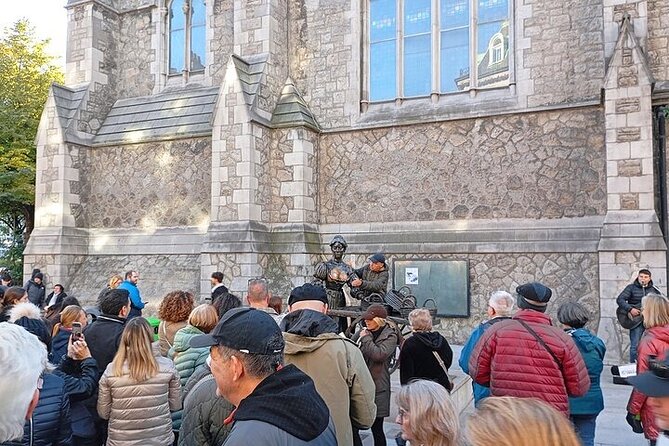
- Molly Malone Statue: the character behind the city’s unofficial anthem
- Trinity College Dublin grounds: Elizabethan roots and a world-famous campus walk
- Temple Bar area: music streets without needing to do pub crawling
- Ha’penny Bridge and the view both ways
- College Green and Parliament’s neighborhood: architecture that explains politics
- Powerscourt Townhouse Centre: an 18th-century elite residence now in plain sight
- St Stephen’s Green: the city pause button
- Dubh Linn Gardens: brickwork and Celtic patterns in a quiet pocket
- Edward Delaney’s Famine Memorial: remembering the Great Irish Famine
- Parliament House and the House of Lords interior option
- The Wall of Fame: Irish bands and music as identity
- Theobald Wolfe Tone: independence ideas and 1798 rebellion
- Dame Lane and the Irish Proclamation copy, April 24, 1916
- After the walk: using the guide’s PDF to plan your food and music
- Is this the right Dublin experience for you?
- FAQ
- How long is the Dublin Private Walking Tour?
- Is this a private tour?
- How much does the tour cost?
- Where do we meet?
- Can the guide pick us up from a hotel?
- What language is the tour offered in?
- Are entrance fees included?
- Does the tour include any indoor time at Parliament House?
- Is the tour suitable for young children?
- Can I cancel for a full refund?
- What do you get besides the walking guide?
Key things I’d watch for

- Truly private, 3-hour attention with your group only, no blending into a crowd.
- David’s high-energy storytelling, including humor and music moments, plus a portfolio of extra photos.
- Practical Dublin orientation and a digital PDF guide for food, drinks, and Irish traditional music venues.
- A tight city loop that starts around Molly Malone and finishes at College Green, with flexible ending options.
- Outside-first landmarks (so you still see a lot even if you skip ticket lines).
- A thoughtful mix of Dublin moods, from old power and politics to parks, bridges, and the Great Famine memorial.
Other Dublin walks with the wind behind you
- Dublin Highlights and Hidden Gems Guided Walking Tour★ 5.0 · 6,020 reviews
- Dublin: Highlights and Hidden Gems Walking Tour★ 4.9 · 2,140 reviews
- 1916 Rebellion Walking Tour★ 5.0 · 1,605 reviews
- 90 Minute Dublin Walking tour and Sightseeing tips★ 5.0 · 916 reviews
Why this Dublin Private Walking Tour is worth your time
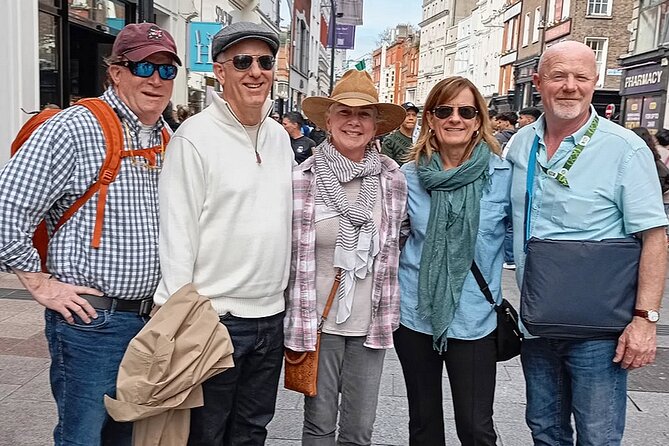
A good city walk does two jobs at once. It helps you find your bearings fast, and it turns famous streets into something you actually understand. This one is built around a logical north-to-south Dublin center loop, so you get a clean picture of where power sat, where students gathered, where music became identity, and where Ireland’s modern story is written in stone.
For me, the standout value is that it is 100% private. You can ask questions at your speed, linger when something grabs you, and skip what does not. You are not stuck with a rigid group pace, and that matters a lot in a place like Dublin where each block can change the mood.
The price, $144.03 per person for about three hours, looks steep until you think about what you are really buying: a licensed guide, nonstop attention for your group, and planning tools you can use after the walk. Add in the fact that many stops are exterior viewpoints, and you avoid losing time to ticket queues when you do not have much vacation time.
Where the walk starts, and how to make it easy on your feet
The main meeting point is the Molly Malone Statue area on Suffolk St, Dublin 2 (D02 KX03). The tour generally ends at College Green, though you can choose a convenient finish point if you have another timed plan later.
Pickup is offered, which is a big deal if you are coming from a hotel outside the center. If you want the day to stay low-stress, use pickup. It is also helpful on rainy days, because you are not guessing how to get from your accommodation to the first landmark.
This is a walk, so plan like it is a walk:
- Wear comfortable shoes, because you will be on paved city surfaces most of the time.
- Bring a small umbrella or rain layer. Dublin weather can change quickly.
- Think about timing. If you want any interior access, you will want to be there when things are open.
Dublin Castle: starting with power, 1204 to British administration
Your first big story stop is Dublin Castle, approached from the outside. The key detail here is the timeline: it dates back to medieval times, with the first stone laid in 1204. You get the sense of why this place mattered, not just that it was important.
This exterior approach is smart if you want context without turning your three hours into ticket logistics. You can still see how the castle sits in the city, and the guide can explain how British rule and administration shaped daily life and governance.
A possible drawback is also part of the value: because this is primarily an exterior stop, you will not get the full museum experience here. If you want inside rooms, you will need separate plans.
Molly Malone Statue: the character behind the city’s unofficial anthem

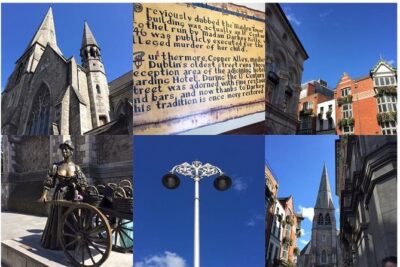
Next up is the Molly Malone Statue, one of the most photographed sculptures in Dublin. This stop is more than a photo opportunity. The character traces back to Dublin’s unofficial singing anthem, and the guide turns that folk reference into something you can place in the city’s culture.
Why I like this stop early: it is a quick cultural on-ramp. It tells you what Dubliners already know, that the city runs on storytelling, songs, and public memory.
If you are the type who likes to know where a nickname comes from, this stop will feel satisfying right away. If you want quiet, crowded photo moments might be a little intense, because this spot is popular.
Other trips where the minibus is yours alone


Trinity College Dublin grounds: Elizabethan roots and a world-famous campus walk
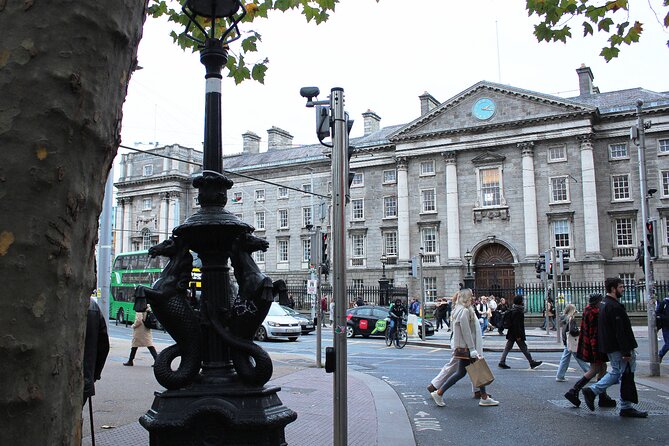
Then you shift to Trinity College Dublin. Founded in 1592 by Queen Elizabeth I, it is Ireland’s oldest university. The walk here is described as an external stroll through the grounds, so you are not stuck waiting for ticket timing.
Trinity is also a visual lesson. You learn how universities shaped Irish civic life, long before modern headlines existed. The campus architecture and layout naturally pull your eyes around, and the guide’s job is to point out what to notice.
A practical note: since this stop is mainly outside, it works well regardless of weather. If interior access is important to you, you can plan extra time later, but this tour focuses on orientation and context.
Temple Bar area: music streets without needing to do pub crawling
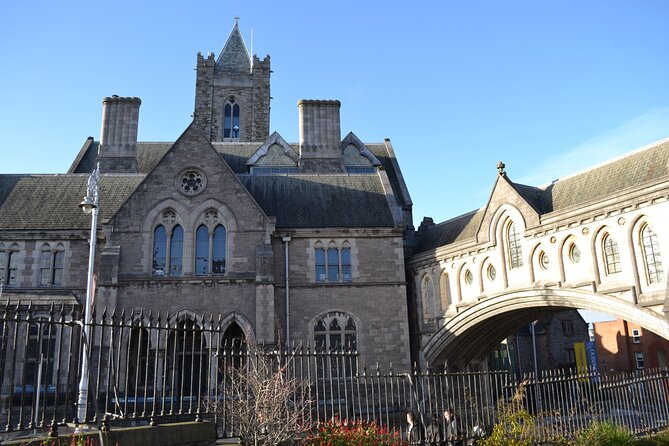
At Temple Bar, you get the story behind the name and the idea behind the area. Temple Bar is famous for the pub scene, but it is also an actual neighborhood area of about 28 acres. The guide uses the geography to explain why the district became a cultural meeting point, especially for people into Irish traditional music and live entertainment.
This stop has one practical benefit: it helps you understand where the nightlife energy is concentrated. That makes it easier to plan a calm evening later, because you know what streets to target and what streets to avoid if you want an easier walk back.
If you are sensitive to noise, treat Temple Bar like a choose-your-own-adventure moment. You might stay out in the lanes for photos and a few key explanations, then move on. The tour keeps the stop time tight, so you do not get stuck in the loudest part longer than you want.
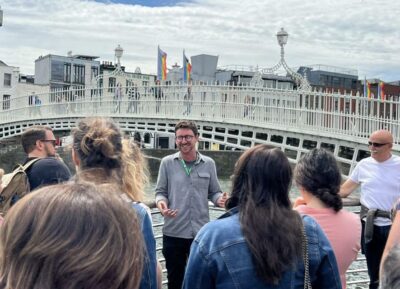
Ha’penny Bridge and the view both ways
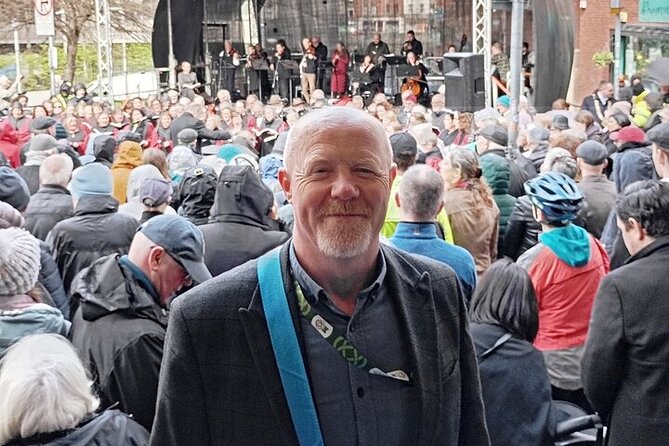
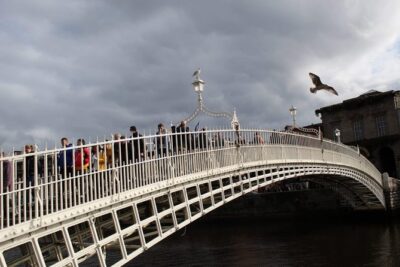
At Ha’penny Bridge, you pause on Dublin’s oldest foot bridge. It links the south and the north side of the city, and the guide points out how easy it is to lose your sense of direction here without a quick viewpoint check.
The bridge is one of the oldest wrought iron bridges in the world, with a history of more than 200 years. This is a great example of how Dublin repeats themes. Power, movement, trade, and migration all show up in the city’s waterways and crossings.
What to do with your time there: look east, look west. Even a minute or two each way changes what you notice about street angles and how the city sits around the river.
College Green and Parliament’s neighborhood: architecture that explains politics

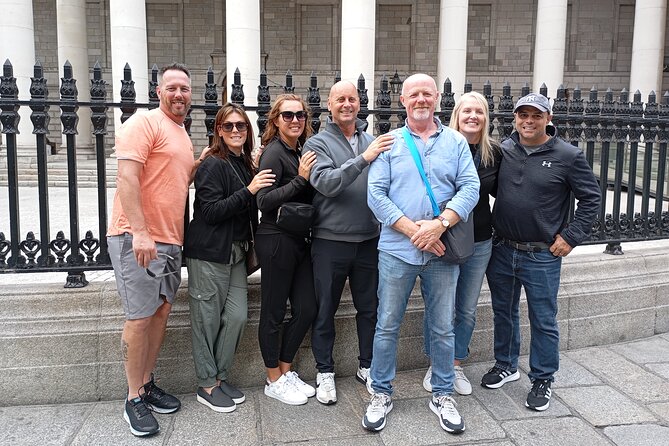
College Green is a three-sided plaza at the heart of Dublin City. It is bordered by major landmarks, including the Bank of Ireland building on the north side, which originally was Ireland’s Parliament House. Trinity sits to the east, so the area becomes a junction between education, government, and public life.
This stop is one of the best for getting a big-picture understanding. The guide ties together what you saw at Dublin Castle and the political thread that shows up again near Parliament House later.
If you like architecture, spend your focus time here. The Georgian and Victorian buildings around the plaza give you visual clues about when Dublin wanted to project authority and stability.
Powerscourt Townhouse Centre: an 18th-century elite residence now in plain sight
Next is Powerscourt Townhouse Centre, a place that many visitors miss because it does not announce itself loudly. The townhouse dates to the 18th century and originally served as the city residence for Richard Wingfield, the 2nd Viscount Powerscourt, and Lady Elizabeth.
The guide’s explanation of the social life matters. This was a hub for Dublin’s elite, hosting lavish parties and events. When you step into this kind of space, you can feel how power also worked through networks and social access, not only through official institutions.
This stop is short by design, so use it as a visual break in the walk. If you want longer time, you can usually explore further on your own afterward.
St Stephen’s Green: the city pause button
St Stephen’s Green Park is a classic center oasis, around 22 acres. You get gardens, flower beds, lakes, and wildlife, plus winding walkways and sculptures that reflect Irish history.
This is a practical stop as much as a scenic one. After earlier city landmarks and political sites, your brain needs a reset. The guide helps you read the park, not just stroll it, so you learn why these spaces were shaped the way they were.
If rain hits, this part is still workable. Even under gray skies, the park’s layout makes it easy to keep moving without feeling trapped.
Dubh Linn Gardens: brickwork and Celtic patterns in a quiet pocket
At Dubh Linn Gardens, you get another smaller stop that rewards attention. It sits in the heart of the city and is known for its unique brickwork and Celtic patterns.
The guide shares the garden’s own local story and how it connects to Dublin’s identity in a way you do not always get from major landmarks. If you enjoy detail, this is where you’ll probably slow down, because the design is meant to be noticed up close.
This is also where you can decide whether you want extra time. If you want a quick look, you can move on. If you love design and symbols, you can linger a bit more.
Edward Delaney’s Famine Memorial: remembering the Great Irish Famine
Then the tone turns serious at Edward Delaney’s Famine Memorial. This tribute honors over one million victims of the Great Irish Famine of 1845. The memorial uses haunting sculptures of emaciated figures to represent suffering and starvation.
This stop matters because it anchors Ireland’s modern story in a real, human tragedy. The guide explains how displacement and death helped shape one of the largest Irish diaspora populations in the world.
It is the kind of stop that can hit hard even if you have read about the famine before. If you prefer lighter topics, know this is part of the route, and you may want to take a breath before moving on.
Parliament House and the House of Lords interior option
Near Parliament House, you get Dublin’s old Parliament building that contains the original House of Lords, now associated with the Bank of Ireland. It was constructed in the early 18th century, and the guide notes that you may be able to enter into the House of Lords as it was over 250 years ago.
Here is the practical consideration: entry is subject to opening times. The tour does not promise it every day. If interior access is important to you, plan to be flexible, and ask your guide what you can expect that day.
Either way, the exterior context is useful. You understand why the city center holds political artifacts in plain sight.
The Wall of Fame: Irish bands and music as identity
The walk then turns toward pop culture and musical heritage at the Wall of Fame. This is a tribute to legendary Irish bands and singers who contributed to both Irish and world music.
I like this stop because it reminds you that Dublin is not only politics and stone. Music is part of how Dubliners project their voice. The guide’s storytelling connects the names on the wall to the wider Irish cultural thread.
If you care about modern Irish music, you will likely enjoy this part. If you just want a break from heavy topics, it also works because it is shorter and less solemn than some memorial stops.
Theobald Wolfe Tone: independence ideas and 1798 rebellion
At the Theobald Wolfe Tone Statue, you focus on one of the key political figures associated with Irish nationalism. The guide explains Tone’s role in the quest for greater autonomy and independence from British rule and notes his influence on the 1798 rebellion.
This stop fits naturally after Parliament House and the proclamation-related stop later on. You start to see a pattern: Dublin is full of symbols connected to the push and pull between governance, identity, and rebellion.
If you like political history, ask your guide to connect Tone’s goals to the later independence documents you will see on Dame Lane.
Dame Lane and the Irish Proclamation copy, April 24, 1916
Finally, you land at Dame Lane, for a look at a copy of the original Irish Proclamation, issued April 24, 1916 during the Easter Rising against British rule.
The guide explains the core message: it declared an independent republic and outlined rights, including equal citizenship and respect for all people’s rights. The Proclamation is treated as a cornerstone document in Irish history, and the guide links that idea to modern Ireland.
This is the emotional finish for the political story. When you walk here after seeing statues and Parliament architecture, you can feel how a document can matter just as much as a building.
From there, you wrap up around College Green, with options to adjust your ending point if you have another timed plan.
After the walk: using the guide’s PDF to plan your food and music
One of the most practical parts of this experience is the planning support. You get a digital PDF with recommendations for the best cafes, restaurants, pubs, and Irish traditional music venues. I like this approach because it saves you from aimless searching after a day of walking.
Also keep the guide’s city orientation in mind. Knowing how to move between key neighborhoods helps you spend less time figuring things out and more time enjoying the evening.
If you want an easy next step: pick one food spot from the PDF, and pick one music stop. If you try to do five things at night, Dublin will win and your feet will feel it in the morning.
Is this the right Dublin experience for you?
Book this tour if:
- You want a private 3-hour overview that mixes major sights with quieter pockets.
- You care about both architecture and story, not just photo stops.
- You want planning help for food and Irish traditional music after your walk.
- You like guides who show energy, share songs at the right moments, and bring extra photos to explain context.
Skip or add extra time if:
- You want lots of ticketed museum interiors. This walk focuses on landmark exteriors and short stop pacing, with interior access only when available.
- You are traveling with very young children. The tour is not recommended for babies or children under 5.
FAQ
How long is the Dublin Private Walking Tour?
The tour lasts about 3 hours.
Is this a private tour?
Yes. It is a 100% private experience, and only your group participates.
How much does the tour cost?
The price is $144.03 per person.
Where do we meet?
The meeting point is the Molly Malone Statue area on Suffolk St, Dublin 2 (D02 KX03).
Can the guide pick us up from a hotel?
Yes, pickup is offered. The guide can meet guests at hotels or city center accommodations, or at the central meeting point.
What language is the tour offered in?
The tour is offered in English.
Are entrance fees included?
Entrance into ticketed or paid attractions is not included. Some stops are external, while any interior entry is subject to times and opening.
Does the tour include any indoor time at Parliament House?
It can include entry into the House of Lords area, but entry depends on times and opening.
Is the tour suitable for young children?
It is not recommended for babies or children under the age of 5 years.
Can I cancel for a full refund?
Yes. You can cancel up to 24 hours in advance for a full refund.
What do you get besides the walking guide?
You get a digital PDF with recommendations for cafes, restaurants, pubs, and Irish traditional music venues, plus advice on navigating Dublin and using transport.
If you want one tour that gives you structure for the rest of your Dublin trip, this private walk is a strong choice. It is also a smart pick if you care about the story behind the city, from medieval seats of power to the Proclamation and the famine memorial, all tied together with practical guidance you can use the same day.
More of Dublin Underfoot
The Wider Dublin Pile
Elsewhere on The Ireland Traveler
Lately added to the Dublin pile
- Waterford Crystal and Kilkenny Full-Day Rail Tour from Dublin
★ 5.0 · 3 reviews - Turtle Bunbury’s Dublin: A Self-Guided Audio Tour from a Celebrated Author
★ 5.0 · 3 reviews - Cliffs of Moher and The Burren Private Tour from Dublin
★ 5.0 · 3 reviews - Dublin Full-Day Tour through Boyne Valley
★ 5.0 · 3 reviews - Rock Of Cashel And Blarney Castle Private Chauffeur Full Day Sightseeing Tour
★ 4.5 · 3 reviews - Private Irish Fusion Meal in a Modern Home in Skerries, Dublin
★ 5.0 · 3 reviews
More Walking Tours, side by side.
 ★ 5.0Dublin Highlights and Hidden Gems Guided Walking TourFrom $296,020 reviews
 ★ 4.9Dublin: Highlights and Hidden Gems Walking TourFrom $272,140 reviews
 ★ 5.01916 Rebellion Walking TourFrom $271,605 reviews
 ★ 5.090 Minute Dublin Walking tour and Sightseeing tipsFrom $21916 reviews
 ★ 5.02-Hour Historical Walking Tour from DublinFrom $22875 reviews
 ★ 4.7Historical 2-Hour Guided Walking Tour of DublinFrom $22865 reviews
 ★ 5.0Dublin Traditional Irish 3 Course Meal Walking Tour with LocalFrom $107755 reviews
 ★ 4.9Dublin: Mythology, Folklore and Legends Walking TourFrom $27703 reviews
Other lists this one is on