
REVIEW · IRELAND
2-Hour Historical Walking Tour from Dublin
A quick history fix for cold Dublin days. I love the history-postgraduate guides (clear, story-driven, often funny) and the smart 2-hour length that still leaves you free for the rest of the day. The main catch is it’s genuinely history and politics heavy, so you need to pay attention, and it can feel dense if that’s not your vibe.
You meet your guide opposite Trinity College at the Henry Grattan Monument, then you move through an efficient loop of Dublin landmarks tied to real turning points. I also like that costs stay reasonable for what you get: group pricing, a small cap of 25 people, and free admission tickets for the stops listed (with one key exception).
One consideration: this is a walking tour with a moderate fitness level, and in practice you should expect steady walking plus some time outdoors in whatever weather you get.
In This Review
- Key things to know before you go
- Why this 2-hour Dublin walk is such a good start
- The meeting point: Grattan Monument by Trinity College
- Stop 1: Trinity College Dublin and the Book of Kells context
- Stop 2: Bank of Ireland and the politics of architecture
- Stop 3: Temple Bar and how Dublin reinvented itself
- Stop 4: Wood Quay Amphitheatre and Viking-era clues
- Stop 5: Four Courts and the start of the Irish Civil War
- Stop 6: Christ Church Cathedral, Strongbow, and the medieval layers
- Stop 7: Dublin City Hall and Daniel O’Connell’s Catholic Emancipation
- Stop 8: Dublin Castle, King John, and where Dublin’s name comes from
- Pace and practical value: what $22.98 buys you in real terms
- Who should book this walk, and who might want a different style
- Should you book this Dublin historical walking tour?
- FAQ
- How long is the 2-hour Historical Walking Tour from Dublin?
- Where do I meet the guide?
- What is the group size?
- Is the Book of Kells included?
- What price should I expect?
- What language is the tour offered in?
- Is free cancellation available?
Key things to know before you go
- Small group cap of 25 keeps the pace human and makes questions feel doable
- History postgraduates as guides means timelines and context come with strong explanations
- You start opposite Trinity and finish at the Christ Church Cathedral area so you end right where more exploring is convenient
- Book of Kells entry is not included, even though Trinity is a major stop
- It runs about 2 hours, with a chance of going a bit longer (build in buffer time)
Other Dublin walks with the wind behind you
- Dublin Highlights and Hidden Gems Guided Walking Tour★ 5.0 · 6,020 reviews
- Dublin: Highlights and Hidden Gems Walking Tour★ 4.9 · 2,140 reviews
- 1916 Rebellion Walking Tour★ 5.0 · 1,605 reviews
- 90 Minute Dublin Walking tour and Sightseeing tips★ 5.0 · 916 reviews
Why this 2-hour Dublin walk is such a good start
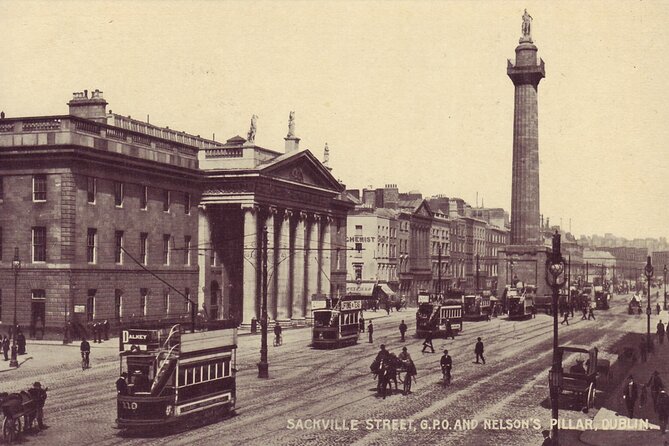
This tour is built for orientation. In about two hours, you cover the places that shaped Dublin from medieval power to colonial rule, Viking roots to Irish independence-era conflict. It is not a slow “look at the street” stroll, and it is not trying to be. It’s a guided timeline you can stand inside, literally around you, as you connect why each building exists and what it meant.
The value is partly practical. At $22.98 per person for a group up to 25, you’re paying for expert interpretation, not just being led from A to B. And because it’s short, you’re not locked into an all-day commitment. Plan the rest of your day for wandering, museums, pubs, or just repeating the stops that grabbed you.
The other value is that the guides are history postgrads. That matters because Dublin history has plenty of characters, dates, and competing narratives. A good guide helps you keep it straight, like moving from chapter to chapter instead of getting lost in footnotes. In the reviews, guides like Caolan Maher, Daragh, Eoin, Jodie, Jody, John D., and Colm come up repeatedly, often praised for clear delivery, good story pacing, and jokes that keep the group awake in winter.
The meeting point: Grattan Monument by Trinity College
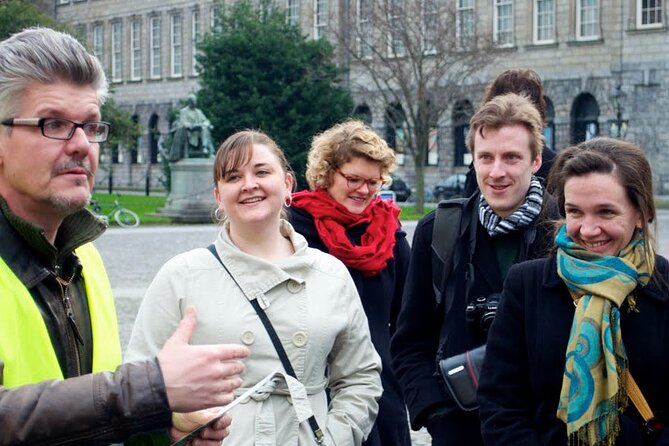
You start at the Henry Grattan Monument on College Green, opposite Trinity College Dublin, near the front gate. This is a smart place to begin because Trinity is one of Dublin’s big “anchor” landmarks. Once you’re there, you get your mental map quickly: College Green sits right in the historic heart of the city, and you’re close to the main axis of where the walk goes next.
You’ll want to arrive a few minutes early. Even though the itinerary is tight, the group needs to form up and the guide needs a moment to set expectations. Also, bring headphones only if you’re the type who can’t stop looking at your phone, because the tour is all listening and you’ll want your attention on the person leading.
This is also the spot where you get the first payoff for your time: you’re about to see Ireland’s oldest university and then keep building context from there.
Stop 1: Trinity College Dublin and the Book of Kells context
The tour begins at Trinity College Dublin, with about 20 minutes here. You’ll hear how the university dates to 1592, and you’ll also get to grips with its most famous artefact, the Book of Kells, an 8th-century manuscript of the four Gospels written in Latin.
Here’s the practical part. Entry to see the Book of Kells is not included. So if that manuscript is your priority, you’ll want to plan that separately. The tour still pays off if you love learning what you’re looking at, because the guide’s explanation gives you the why behind the fame. Without that context, the Book of Kells can feel like a standalone celebrity object. With it, it becomes part of a much bigger story.
You also benefit from starting at Trinity rather than, say, a cathedral. Trinity helps you understand Dublin’s long connection to scholarship and power, and it makes the later political stops feel more connected.
Stop 2: Bank of Ireland and the politics of architecture
Next up is the Bank of Ireland stop, around 10 minutes. This building originally served as Ireland’s colonial parliament, built in 1729, then abolished by the Act of Union in 1800. The tour ties it to the period often described as Protestant Ascendancy, and it connects that to the building style, including the neo-classical architecture.
This stop works because it teaches you to read stone. You start noticing how architecture signals authority. You’re not just seeing a bank, you’re seeing a former seat of governance and an emblem of who held power when. It’s one of those “now I can’t unsee it” moments, because after this, many other civic buildings across Dublin start looking like they’re designed for messaging, not comfort.
If you prefer only peaceful, artsy stops, this is the first place you might feel the tour getting more political. But even if you’re not into politics, it’s hard to ignore that a parliament building has a story to tell.
Other pieces of the past in Dublin
Stop 3: Temple Bar and how Dublin reinvented itself
Then you reach Temple Bar, again about 10 minutes. This area was originally earmarked for demolition, but it was repurposed as Dublin’s Cultural Quarter in the 1990s.
The useful idea here is Dublin’s willingness to change its own image. The tour doesn’t treat Temple Bar like a postcard. Instead, it explains how a neighborhood got reshaped through planning and identity, which is exactly what you need before you spend time in the area on your own.
If you’re thinking about your evening plans, this stop helps you decide what kind of Dublin you want to seek out next. Temple Bar can be lively and touristy. It can also be a launching pad. The tour gives you the background so you can choose on purpose rather than by accident.
Stop 4: Wood Quay Amphitheatre and Viking-era clues
At Wood Quay Amphitheatre, you get about 10 minutes. Wood Quay is tied to archaeological excavations in the 1980s that uncovered parts of the Viking city, with the city said to have been founded around AD 840.
This is one of the more fascinating stops because it reframes Dublin as older than the obvious medieval story. You’ll hear the Viking angle and how the city developed. And even if you don’t leave with a full mental map of the archaeology, you’ll take away the important takeaway: Dublin’s layers stack, and the ground itself remembers.
If you’re a “teach me how to see” traveler, this stop is a win. It trains your eye for what’s hidden under the streets.
Stop 5: Four Courts and the start of the Irish Civil War
Four Courts takes about 20 minutes and gets heavier. It’s Ireland’s legal headquarters, and the tour connects it to the start of the Civil War in June 1922. The conflict was between those who supported and those who opposed the Treaty of December 1921, which had ended the War of Independence from 1919 to 1921.
This is where the tone can shift from story to real historical friction. It’s also where the tour’s strength shows. A good guide can keep events understandable even when the subject is complicated. The reviews often praise guides for clear structure, a strong ability to explain recent history, and good pacing.
Still, if you’re hoping for a mostly culture-focused tour with light politics, this is the stop to mentally brace for. This is history in action, and the buildings are the evidence.
Practical tip: if you know you get tired during dense political timelines, pace yourself. Stand where you can listen well. If you need to, take a short breather, but don’t check out mentally, because the guide ties this stop back to everything that follows.
Stop 6: Christ Church Cathedral, Strongbow, and the medieval layers
Next is Christ Church Cathedral, about 10 minutes. Dublin’s oldest cathedral dates to around 1030, then was rebuilt in stone in the 1170s by Strongbow, who played a central role in the original English invasion in the 1170s.
This stop is powerful because the cathedral is both a place and a timeline. You hear how religious power, conquest, and city life intersected across centuries. Even if churches blur together for you in other cities, this one has a specific role in Dublin’s story that connects to both earlier and later stops.
Also, because the tour ends near this area, you get a useful link between the walking timeline and where you can keep exploring after the tour.
Stop 7: Dublin City Hall and Daniel O’Connell’s Catholic Emancipation
City Hall is another about 10 minutes, and the tour brings in Daniel O’Connell. You’ll see a statue of O’Connell, described as Dublin’s first Catholic Lord Mayor in 1840. He led a successful campaign for Catholic Emancipation in 1829, ending anti-Catholic laws, which is why he’s known as The Liberator.
This is a great stop for understanding how change happened step by step. It’s not only about battles. It’s also about law, rights, and political persuasion. The tour makes it easier to connect Ireland’s religious history to its governance history.
If you’re the kind of traveler who likes human figures, O’Connell gives you a recognizable name to carry through the rest of the walk.
Stop 8: Dublin Castle, King John, and where Dublin’s name comes from
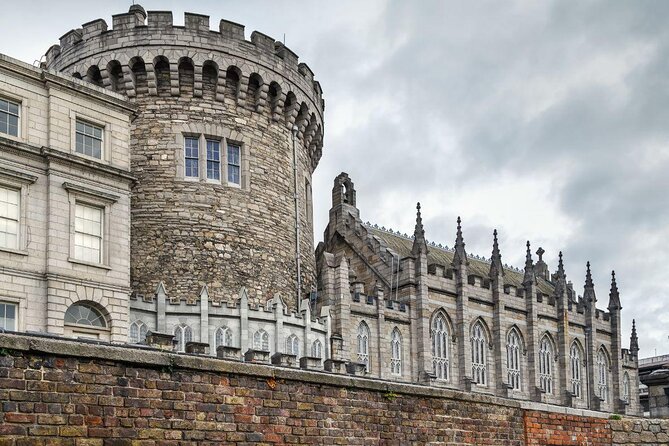
The final major stop is Dublin Castle, about 10 minutes. It was originally built by King John in 1204 and served as the seat of British administration until 1922. The tour also explains the name connection to Dubh Linn, the Black Pool, from which Dublin gets its name.
This is the “big picture” finish. After walking through Trinity’s scholarship, parliament-era power, medieval conquest echoes, legal conflict, and civic emancipation, Dublin Castle pulls it all together into one narrative of rule and governance.
Even though it’s only a short stop, it helps you understand why Dublin’s central institutions look the way they do. When you finish near Christ Church Cathedral, you’re not just done. You’re set up to continue making sense of the city on your own.
Pace and practical value: what $22.98 buys you in real terms
For $22.98, you’re essentially buying:
- a structured two-hour timeline across eight stops
- a small group format (maximum 25)
- a history postgraduate guide
- free admission tickets tied to the listed stops
The only notable exception is the Book of Kells entry, which is not included. So budget separately if you want to see the manuscript itself.
Also plan for weather. One recurring theme in the reviews is tours running in freezing or rainy conditions while guides keep the group engaged. Dress like you’re going to be outdoors for real time, not indoor time. Comfy shoes are non-negotiable, since you’ll be moving between central city points for most of the tour.
And yes, build in a little buffer. One review mentioned the tour running about a half hour longer than expected. That’s not unusual with dense topics, questions, and slower walking when it’s slippery.
Finally, the tour is in English, uses a mobile ticket, and it’s near public transportation. If you’re arriving by bus or tram or you’re walking in from central lodging, it’s easy to plug in.
Who should book this walk, and who might want a different style
Book it if you want the story behind the buildings. If you’re curious how Dublin got the way it is, this tour gives you the timeline fast. It’s especially good for the start of your trip, because it helps you revisit sites later with understanding.
Choose it if you like a guide with a strong voice and a knack for turning history into a clear sequence, like you see praised for Eoin, Jodie, Jody, John D., Caolan Maher, and Colm. The humor and acting energy described in reviews also helps if you get restless with lectures.
Skip or reconsider if:
- you don’t enjoy politics and prefer culture without the power struggles
- you struggle when a tour is dense and detail-heavy
- you’re not comfortable with a steady walk for roughly two hours
That one lower rating is basically a warning: the tour can feel very in-depth and political, and it may be harder to follow if you want more casual storytelling focused only on culture.
Should you book this Dublin historical walking tour?
Yes, if you want an efficient, guide-led introduction to Dublin’s big historical themes, this is a solid pick. The guide caliber matters, the group size helps, and the route hits major landmarks that you’ll likely want to revisit later.
Book it early in your trip if possible, so you can use the context to plan what comes next. And if the Book of Kells is a must for you, plan that ticket separately, because it’s the one major item not covered in the walk.
If you like history with dates, causes, and consequences tied to real places, you’ll enjoy it. If you want light and mostly scenic, you may prefer a different kind of Dublin walk.
FAQ
How long is the 2-hour Historical Walking Tour from Dublin?
The tour runs for about 2 hours.
Where do I meet the guide?
You meet at the Henry Grattan Monument on College Green, Dublin, opposite Trinity College Dublin.
What is the group size?
The tour has a maximum of 25 travelers.
Is the Book of Kells included?
Entry to the Book of Kells is not included, even though Trinity College Dublin is the first stop.
What price should I expect?
The price is $22.98 per person.
What language is the tour offered in?
The tour is offered in English.
Is free cancellation available?
Yes. You can cancel up to 24 hours in advance for a full refund.
More of Dublin Underfoot
The Wider Dublin Pile
Elsewhere on The Ireland Traveler
Lately added to the Dublin pile
- Waterford Crystal and Kilkenny Full-Day Rail Tour from Dublin
★ 5.0 · 3 reviews - Turtle Bunbury’s Dublin: A Self-Guided Audio Tour from a Celebrated Author
★ 5.0 · 3 reviews - Cliffs of Moher and The Burren Private Tour from Dublin
★ 5.0 · 3 reviews - Dublin Full-Day Tour through Boyne Valley
★ 5.0 · 3 reviews - Rock Of Cashel And Blarney Castle Private Chauffeur Full Day Sightseeing Tour
★ 4.5 · 3 reviews - Private Irish Fusion Meal in a Modern Home in Skerries, Dublin
★ 5.0 · 3 reviews
More Historical Tours, side by side.
 ★ 5.0Dublin Historical Centre Food Tour with 8 Food Tastings & DrinksFrom $1251,718 reviews
 ★ 4.7Historical 2-Hour Guided Walking Tour of DublinFrom $22865 reviews
 ★ 4.5Dublin to Cork, Blarney Castle & Cóbh Heritage Centre by trainFrom $195510 reviews
 ★ 4.8Dublin: Jeanie Johnston Tall Ship Irish Famine History TourFrom $16431 reviews
 ★ 4.3Dublin’s Haunted History Walking TourFrom $31345 reviews
 ★ 5.0Deliciously Dublin: The Artisan Donut Walking & History TourFrom $70329 reviews
 ★ 4.7Cork: Guided Historical Walking TourFrom $26310 reviews
 ★ 4.8Galway: Dark History Guided City Walking TourFrom $23236 reviews
Other lists this one is on