
REVIEW · IRELAND
Small Group Bucket List Sights Walking Tour with a Local Guide
Dublin, told in 12 quick stops. This small-group walking tour strings together the city’s biggest sights with story-driven stops, from Vikings to Tudor and beyond, all in about 2 hours. I like the tight pacing because it helps you get your bearings fast, and the guide-led Q&A style makes the walk feel more like a conversation than a lecture.
You also get real value for the money: it’s $20.52 per person and you cover a lot of central ground, with plenty of explanation at each landmark. One thing to plan for, though, is that several major buildings are exterior-focused, and admission tickets are not included for many stops, so you may need to budget extra if you want to go inside.
In This Review
- Key Highlights You’ll Care About
- A Central Dublin Walk That Ends at Trinity
- Small Group Size, Local Guide Energy, and Real Conversation
- Christ Church Cathedral: Vikings, Normans, and Whiskey Money
- St. Patrick’s Cathedral and the Guinness-Era Renovation
- Dubh Linn Gardens: A Free Stop and a Viking Moored-Boat Moment
- Dublin Castle and City Hall: The 700-Year Government Layer
- Temple Bar to Merchant’s Arch: Tudor Layouts and Dublin Contrasts
- Millennium Bridge to Ha’penny Bridge: River Views with Big Time Jumps
- College Green, Molly Malone, and Trinity College Dublin
- Price and Value: What $20.52 Buys in Dublin
- Who This Walking Tour Is Perfect For
- Should You Book This Walking Tour of Central Dublin?
- FAQ
- How long is the walking tour?
- How much does the tour cost?
- What time does the tour start, and where does it meet?
- Where does the tour end?
- Is this a small group tour?
- Is the tour in English?
- Do I need admission tickets for the sites?
- Do I get a mobile ticket?
- What if I need to cancel?
- Is service animal access allowed and is public transport nearby?
Key Highlights You’ll Care About
- Christ Church Cathedral basics, without the entry ticket, plus the Vikings-to-Normans story and that 19th-century whiskey-money renovation angle
- St. Patrick’s Cathedral and the Guinness renovation, including why the cathedral is tied to a famous patron-street legend
- Dubh Linn Gardens is free, and the guide links it to Viking long boats moored in Dublin in the 9th century
- Dublin Castle and the flag lesson at City Hall, where the walk turns to political and cultural context, not just buildings
- River crossings with big time-period contrasts, from Celts on one side to Silicon Docks on the other
- Your finish at Trinity College Dublin, right on College Green, near the Book of Kells exhibition area
Other Dublin walks with the wind behind you
- Dublin Highlights and Hidden Gems Guided Walking Tour★ 5.0 · 6,020 reviews
- Dublin: Highlights and Hidden Gems Walking Tour★ 4.9 · 2,140 reviews
- 1916 Rebellion Walking Tour★ 5.0 · 1,605 reviews
- 90 Minute Dublin Walking tour and Sightseeing tips★ 5.0 · 916 reviews
A Central Dublin Walk That Ends at Trinity
This tour is built for one main goal: central orientation with story time. You start at 121 R137, Wood Quay and finish at Fox House, 37 College Green, with the meeting point at College Green just outside Trinity College Dublin. The scheduled start is 10:00 am, and the route runs around 2 hours with short stops designed for your feet, your questions, and the light of the day.
The walking pace is usually friendly because each landmark is given its own moment, about 10 minutes at most stops. That matters in Dublin, where you can easily waste time in crowds if you try to DIY every stop. Here, the route keeps you pointed to the next landmark, while the guide handles the context so you are not guessing what matters.
Small Group Size, Local Guide Energy, and Real Conversation
This is capped at 25 travelers, which is where the magic usually starts on city walks. Smaller groups mean you can ask questions without yelling over everyone’s selfie stick, and your guide can adjust on the fly if the group is curious about Ireland’s political twists or the big-name sites.
From the way guides like Peter, Martin, and Rob are described, the tone tends to be upbeat and personal. You can expect that the guide will not just rattle dates, they will connect the sights to what Dublin looks like today, and they often share practical ideas for what to do after the walk.
If you like structured sightseeing but still want a little spontaneity, this format works. If you prefer quiet museums only, you might find the stops more chatty than you want, since it’s a walking tour with guide interaction.
Christ Church Cathedral: Vikings, Normans, and Whiskey Money
Christ Church Cathedral is the opening anchor for a reason. The story starts with Vikings who built an earlier version in wood, then the Normans recast it in stone, and later renovations came thanks to whiskey money in the 19th century. Even if you never buy an admission ticket, that timeline gives you a mental map for what you are looking at and why the building has that layered feel.
This stop is listed for about 10 minutes, and admission is not included. So treat this as a guided exterior moment where you learn how the site’s changes reflect shifting power in Ireland, rather than a full cathedral visit.
A drawback to note: if your dream is to wander inside quietly, plan for separate admission. The good part is that you get a strong orientation story upfront, so your later interior visit, if you choose one, makes more sense.
St. Patrick’s Cathedral and the Guinness-Era Renovation
Next is St. Patrick’s Cathedral, tied to the patron saint’s legend and the island-wide story people love to retell. The tour frames it around a naming tradition and then connects it to the Guinness family, including Sir Benjamin Lee Guinness and the 1860s renovation.
You spend about 10 minutes here, again with admission ticket not included. That makes it a stop for understanding the why, not collecting the facts by reading plaques for yourself.
I like this kind of ordering. By the time you reach St. Patrick’s, you have already heard how Dublin’s old sites evolved over centuries, so the guide can point out the ongoing theme of reinforcement and rebuilding.
Other guides we rate around Dublin



Dubh Linn Gardens: A Free Stop and a Viking Moored-Boat Moment
Then you slip into Dubh Linn Gardens, with a major perk: admission is free. The Chester Beatty Library area sits here, and the tour uses the garden’s quiet setting to highlight a Viking arrival detail. The key idea is that when Vikings arrived in Dublin in the 9th century, they moored their long boats in this area.
This is one of the nicer-feeling stops because gardens break up the city’s hard edges. You also get a story that is slightly different from the usual “cathedral plus castle” route, which keeps the tour from feeling like a checklist.
Since it is free and short, it’s an easy win. If you are the kind of traveler who likes a small pause to reset your brain between bigger monuments, you will appreciate this break.
Dublin Castle and City Hall: The 700-Year Government Layer
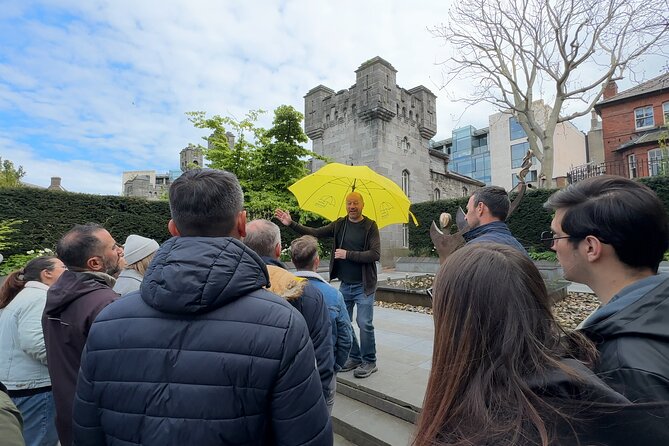
Dublin Castle is where the tour switches to governance and power. The framing is clear: it was the centre of British government in Ireland for 700 years, and the structure is described as a blend of medieval, Georgian, Gothic, and modern architecture. That mix helps you understand why Dublin feels like it has layers you can see, not just layers you read about.
As with other major sites on the route, admission is not included for Dublin Castle in this walk. You will likely be outside, learning how the place functioned and how that history connects to what you see now.
Right beside City Hall, the tour then brings in a national flag lesson. The guide explains the flag’s significance as peace between Catholic and Protestant, and between North and South. That stop is free and outside, which is important because it lets you focus on meaning without turning this into a ticket-buying marathon.
If you tend to remember stories better than dates, the flag context is one of the most useful parts of the whole walk.
Temple Bar to Merchant’s Arch: Tudor Layouts and Dublin Contrasts
The tour moves into Temple Bar, described as one of the oldest parts of the city and now famous for pubs and nightlife. The guide also connects the area to how it was laid out during the Tudor conquest of Ireland, which is a smart way to keep Temple Bar from being only a party stop.
Temple Bar is also listed as free, so you can enjoy the street scene without expecting it to be a paid attraction. Even if you are not there to drink, this part of town tells you what Dublin markets itself for, and how that identity forms on historic ground.
Later, you reach Merchant’s Arch, framed as a contrast point. The walk highlights Crown Alley at one end and Sam Stephenson’s brutalist behemoth, Stephenson Tower, at the other. This is a neat way to remind you that Dublin is not stuck in one century. The city’s past and present sit within walking distance, not museum-wall distance.
This contrast stop is worth your attention even if you do not love architecture, because it gives you a lens for understanding modern Dublin’s style choices.
Millennium Bridge to Ha’penny Bridge: River Views with Big Time Jumps
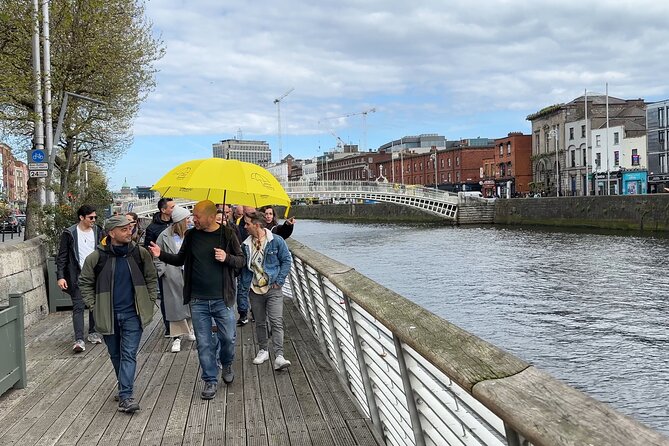
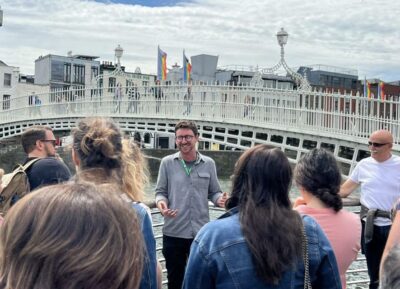
Now for the river. You cross the Millennium Bridge after moving from the south to the north along the River Liffey. The guide uses this spot to compare time periods in a way that sticks: on the east you get a view tied to the Celts building their settlement about 2,100 years ago, while on the west you get a nod to the Silicon Docks and the idea that Americans inspired that shift about 21 years ago.
That is a clever teaching move, because it turns a normal bridge photo moment into a quick timeline in your head.
Then you cross back over the Ha’penny Bridge. This one has two practical, memorable details: it was originally named after the Duke of Wellington, and it used to shake when you walked over it until Harland & Wolff helped change that. Again, the bridge becomes more than a symbol, it becomes a story about design and city life.
Most of the big value here is the pacing. These are short stops, about 10 minutes, but they give you a view reset and break up the dense center of the walking route.
College Green, Molly Malone, and Trinity College Dublin
As you wrap up, you reach College Green, which is another free stop. The tour points you to some of the most beautiful building fronts in the city, with mention of banks and parliament, and explains this was a centre of government and finance. It also includes a line about the city considering itself the 02nd city of the empire, which, odd phrasing or not, helps you remember the vibe of the era.
Then there’s a quick hit for Molly Malone. No tour of Dublin feels complete without saying hello, and this is your lighthearted waypoint before the final big names.
Finally, you conclude outside Trinity College Dublin. The walk notes Trinity as home to the famous Book of Kells exhibition, though the stop itself is listed with admission not included. In practical terms, that means you finish in a great location if you want to keep going on your own. You are already standing where the action is.
This finish is ideal for travelers who want to use the tour as a launching pad. After two hours, you still have energy to wander, grab lunch, or go see the Book of Kells area without feeling like you spent the whole day inside tickets.
Price and Value: What $20.52 Buys in Dublin
At $20.52 per person for about 2 hours, this tour is priced like a “high value orientation” experience. You are not paying for a full museum day, and you are not paying for a long set of admissions either. Instead, you are paying for a guide to connect major landmarks into one clear story, with enough time at each stop to ask questions.
The small-group cap at 25 travelers helps justify the cost. In busy city centers, the difference between 25 people and 5 people is how much you can actually talk and how much your attention gets hijacked by crowd noise.
Just be honest with your expectations. Since many stops list admission as not included, part of the value depends on how you like to travel. If you are happy with exterior viewing plus context, you will get a lot from the price. If you expect to enter every major building during the walk, you will likely feel a bit short and should plan separate ticket visits.
Who This Walking Tour Is Perfect For
This is a great fit if you are in Dublin for a short break and want central Dublin orientation quickly. It also works well if you enjoy the way history connects across centuries, because the tour explicitly jumps between Vikings, Normans, Tudor-era conquest, and later social and political framing.
You will likely enjoy it even more if you like asking questions. The guide style, as seen in the way different named guides are described, tends to encourage interaction and offers extra suggestions beyond the route.
If you are traveling with limited time, this format is also efficient. Twelve stops in about two hours means you see a lot of the map, even though each location gets a short highlight treatment.
Should You Book This Walking Tour of Central Dublin?
Yes, I would book it if your priority is a guided orientation of Dublin’s core landmarks, without turning the day into a pile of tickets. The price is low enough to feel safe, and the short stops mean you can still enjoy the rest of your day on your own.
Skip it or pair it differently if you want a heavy focus on indoor admissions during the walk. Since admission is not included at several signature buildings, you will get the story and the exterior views, but you may still want to come back later for entry if that’s your style.
My practical advice: if Trinity College and the Book of Kells exhibition are on your list, this tour finishes in exactly the right spot. If you like to plan your next move with confidence, this one helps you do that while Dublin is still fresh in your mind.
FAQ
How long is the walking tour?
It runs for about 2 hours (approx.).
How much does the tour cost?
The price is $20.52 per person.
What time does the tour start, and where does it meet?
The tour starts at 10:00 am. The start meeting point is 121 R137, Wood Quay, Dublin.
Where does the tour end?
The tour ends on College Green, outside the front gate of Trinity College at Fox House, 37 College Green, Dublin 2.
Is this a small group tour?
Yes. The tour has a maximum of 25 travelers.
Is the tour in English?
Yes, it is offered in English.
Do I need admission tickets for the sites?
Not all sites are included. Several stops are marked admission ticket not included, while Dubh Linn Gardens is marked free, and some other stops are also listed as free.
Do I get a mobile ticket?
Yes, the tour includes a mobile ticket.
What if I need to cancel?
You can cancel for a full refund if you cancel up to 24 hours before the experience start time.
Is service animal access allowed and is public transport nearby?
Yes. Service animals are allowed, and the tour is near public transportation.
More of Dublin Underfoot
The Wider Dublin Pile
Elsewhere on The Ireland Traveler
Lately added to the Dublin pile
- Waterford Crystal and Kilkenny Full-Day Rail Tour from Dublin
★ 5.0 · 3 reviews - Turtle Bunbury’s Dublin: A Self-Guided Audio Tour from a Celebrated Author
★ 5.0 · 3 reviews - Cliffs of Moher and The Burren Private Tour from Dublin
★ 5.0 · 3 reviews - Dublin Full-Day Tour through Boyne Valley
★ 5.0 · 3 reviews - Rock Of Cashel And Blarney Castle Private Chauffeur Full Day Sightseeing Tour
★ 4.5 · 3 reviews - Private Irish Fusion Meal in a Modern Home in Skerries, Dublin
★ 5.0 · 3 reviews
More Walking Tours, side by side.
 ★ 5.0Dublin Highlights and Hidden Gems Guided Walking TourFrom $296,020 reviews
 ★ 4.9Dublin: Highlights and Hidden Gems Walking TourFrom $272,140 reviews
 ★ 5.01916 Rebellion Walking TourFrom $271,605 reviews
 ★ 5.090 Minute Dublin Walking tour and Sightseeing tipsFrom $21916 reviews
 ★ 5.02-Hour Historical Walking Tour from DublinFrom $22875 reviews
 ★ 4.7Historical 2-Hour Guided Walking Tour of DublinFrom $22865 reviews
 ★ 5.0Dublin Traditional Irish 3 Course Meal Walking Tour with LocalFrom $107755 reviews
 ★ 4.9Dublin: Mythology, Folklore and Legends Walking TourFrom $27703 reviews
Other lists this one is on